Buying an industrial air compressor is not a decision most facility managers make often. For many operations, a compressor purchase happens once every ten to twenty years. That infrequency is exactly what makes it easy to get wrong: buyers who are unfamiliar with the current market, current technology, and their own facility's actual demand profile can end up with a machine that is undersized, oversized, the wrong technology for the application, or purchased from a vendor who will not be there when service is needed.
This guide covers how to size a system, which compressor technologies are right for which applications, how the major brands compare, and what questions to ask before you sign a purchase order. If you are replacing an aging machine, expanding capacity, or setting up a new facility, this is the starting point.
Start Here: Know What You Actually Need
The most common and most expensive mistake in compressor selection is choosing a machine before the facility's compressed air demand has been properly characterized. A compressor that is 20% undersized for peak demand will spend its life in thermal distress. A compressor that is significantly oversized will cycle constantly under low load, which is inefficient and in some cases damaging to the machine's internal components.
Before evaluating any specific compressor, you need to know three numbers.
Required Flow Rate (CFM)
CFM — cubic feet per minute — is the measure of how much air your facility consumes. To determine your required flow rate, you need to add up the CFM demand of every pneumatic tool, process, and piece of equipment that runs simultaneously during your peak production period. Peak demand is the number that matters; average demand will leave you undersupplied when it counts.
The correct approach is a demand survey: walk the facility, catalog every compressed air point of use, identify which tools and processes run concurrently, and total the CFM requirements. Add a 20–25% buffer above the calculated peak to account for system leaks, future expansion, and demand spikes. A qualified compressed air systems specialist can conduct a formal air systems analysis that produces this number with precision rather than estimation.
Required Pressure (PSI)
Most industrial applications operate in the 90–125 PSI range, but the correct operating pressure is determined by the highest-pressure demand point in the facility. A single piece of equipment requiring 150 PSI sets the system pressure for the entire installation if the system is not properly segmented.
Running an entire facility at higher-than-necessary pressure to satisfy one high-pressure application wastes significant energy: for every 2 PSI of excess pressure, energy consumption increases by approximately 1%. A proper system design may use a separate high-pressure circuit for demanding applications rather than elevating system pressure across the board.
Duty Cycle
Duty cycle describes how continuously your compressor will run. A facility that runs one shift five days a week has a very different duty cycle profile than one running three shifts six days a week. Compressors are rated for specific duty cycles, and running a machine beyond its rated duty cycle accelerates wear and reduces service life. Your compressor specification should match your actual operational pattern, not just your peak instantaneous demand.
Compressor Technologies: Which Type Is Right for Your Facility?
Industrial compressed air is produced by several different compressor technologies, each suited to different applications, demand profiles, and facility types. Here is how the main categories compare for LA industrial buyers.
Rotary Screw Compressors
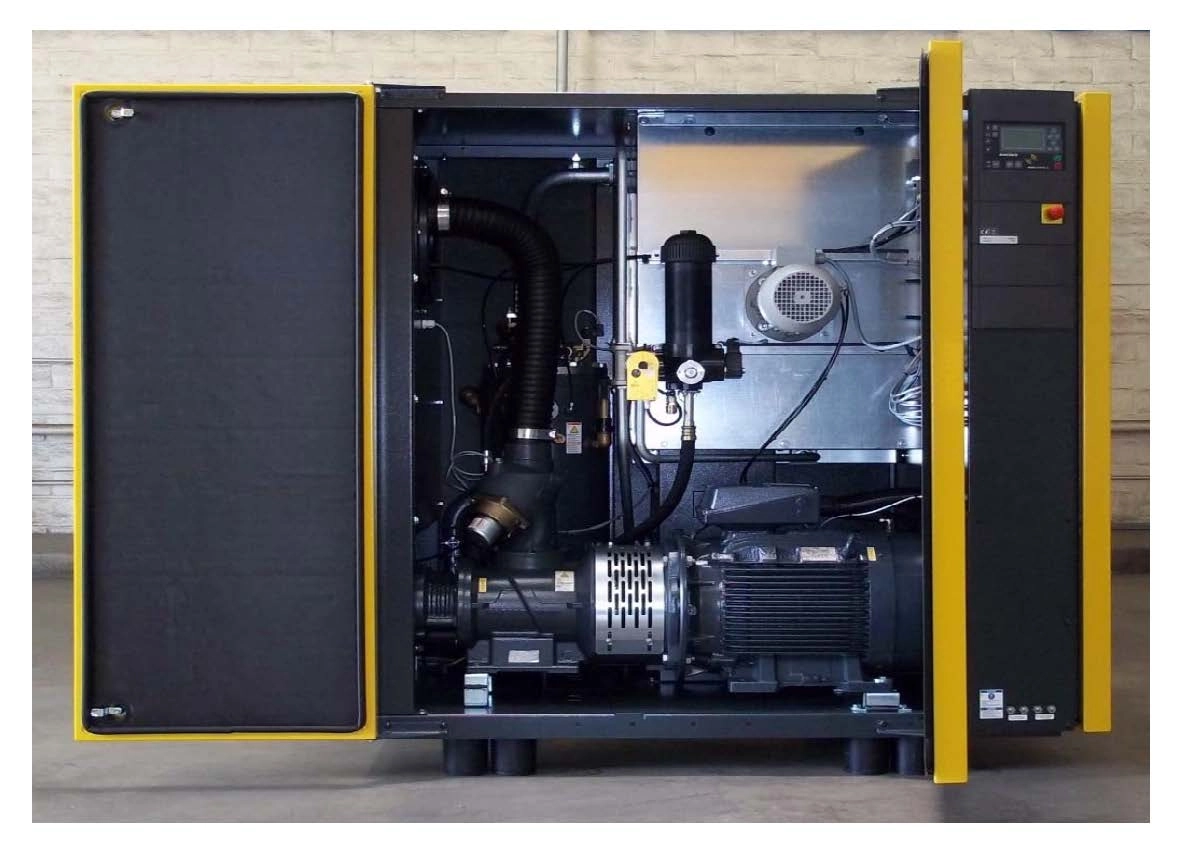
Rotary screw compressors are the dominant technology in LA County industrial environments and the right choice for most continuous or near-continuous production applications. They use two intermeshing helical rotors to compress air, producing a smooth, continuous flow with minimal pulsation. In oil-flooded configurations, the oil also serves as a coolant and sealant, allowing the machine to run at high duty cycles without overheating.
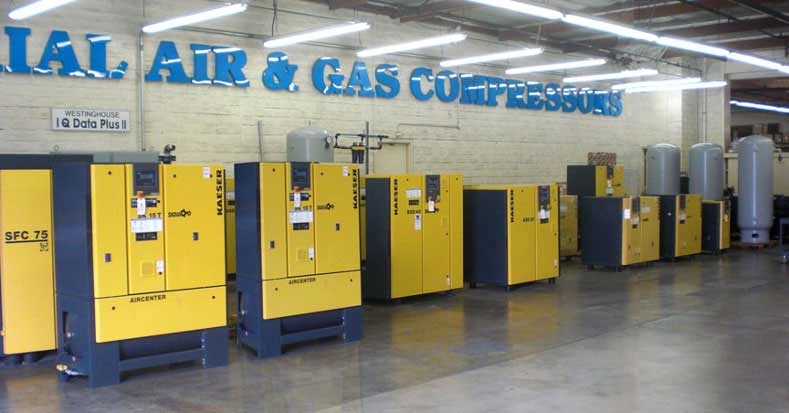
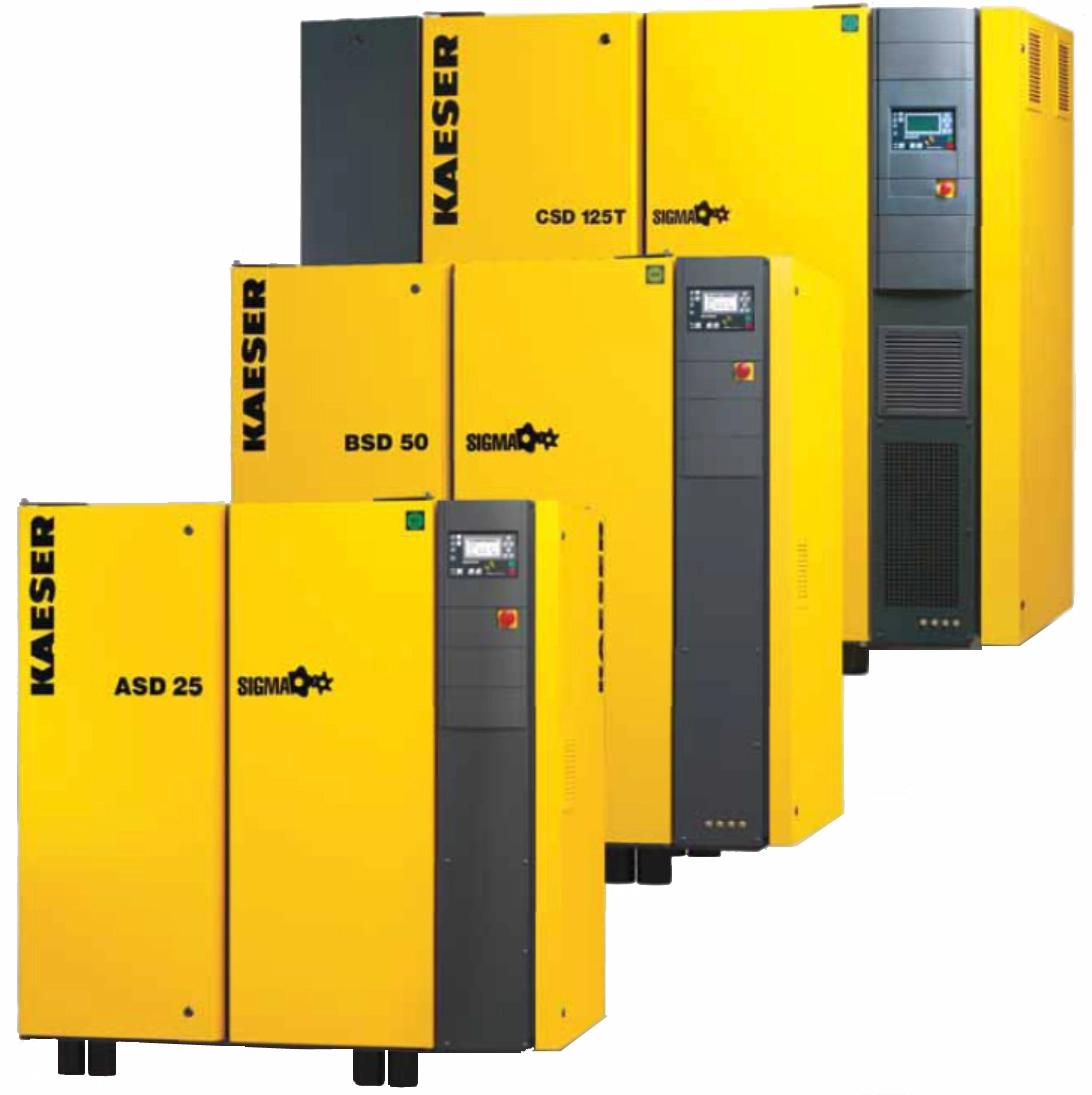
The key advantages of rotary screw machines are continuous duty capability, relatively low maintenance complexity compared to reciprocating machines at equivalent output, and availability across a wide HP and CFM range — from compact 5 HP units to large-frame 500+ HP machines. Kaeser's rotary screw line covers 3 HP through 500 HP with consistent engineering quality across the range.
Rotary screw compressors are the right choice for: manufacturing lines with continuous air demand, facilities running multi-shift operations, applications requiring stable pressure with minimal pulsation, and any installation where maintenance simplicity and uptime are priorities.
Reciprocating (Piston) Compressors
Reciprocating compressors use pistons driven by a crankshaft to compress air in a cylinder. They are inherently intermittent-duty machines: they are designed to run, build pressure in a storage tank, shut off, and repeat. For light industrial, smaller shop, and applications with genuinely intermittent air demand, they are cost-effective and widely available.
The limitations of reciprocating compressors become apparent in continuous or high-duty-cycle applications: piston wear, valve wear, and vibration accumulate faster under continuous load than rotary screw machines experience. For facilities that have outgrown a reciprocating compressor or are setting up an operation that will run air continuously, a rotary screw machine is the right next step.
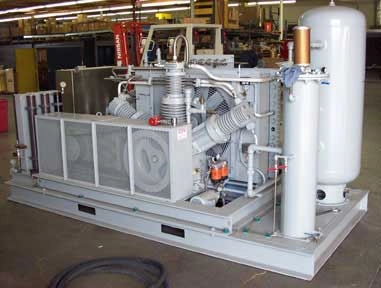
Reciprocating compressors are the right choice for: smaller shops with intermittent air demand, specific high-pressure applications (above 200 PSI) where rotary screw machines are not rated, and backup or standby capacity supplementing a primary rotary screw installation.
Variable Frequency Drive (VFD) vs. Fixed-Speed Compressors
This distinction applies primarily to rotary screw compressors and is one of the most commercially significant decisions in a compressor purchase for LA facilities.
A fixed-speed rotary screw compressor runs at constant motor speed. When demand drops below the machine's full output, it unloads and idles, still consuming 20–40% of full-load power while producing no useful air. Fixed-speed machines are most efficient when running at or near full load continuously.
A VFD compressor uses a variable frequency drive to adjust motor speed in real time, matching compressor output precisely to current demand. When demand drops, the motor slows down, and energy consumption drops proportionally. The DOE estimates that VFD compressors in variable-demand environments can reduce energy consumption by 35–50% compared to fixed-speed equivalents.
The tradeoff is upfront cost: VFD compressors typically cost 20–30% more than comparable fixed-speed units. In facilities with genuinely variable demand (production that fluctuates across shifts, seasonal variation, or processes with high load variation), the energy savings pay back that premium relatively quickly. Southern California Edison's industrial electricity rates make the VFD ROI calculation particularly favorable in LA County.
Fixed-speed compressors remain the right choice for facilities running at or near full load continuously, where the VFD premium cannot be recovered through energy savings.
How the Major Brands Compare
The industrial air compressor market includes several major brands with meaningful differences in engineering quality, parts availability, dealer networks, and total cost of ownership. Here is an honest comparison of the brands LA manufacturers are most likely to encounter.
| Brand | Positioning | HP Range | LA Availability |
|---|---|---|---|
| Kaeser | Premium efficiency; German engineering; low total cost of ownership; strong authorized dealer network | 3–500+ HP | American Compressor Co. — authorized dealer, Santa Fe Springs |
| Atlas Copco | Premium tier; closest direct competitor to Kaeser in quality and efficiency; strong global parts network | 3–500+ HP | Multiple LA-area dealers |
| Ingersoll Rand | Broad market; mid to premium; large installed base in US industry; widely serviced | 5–500+ HP | Broad LA dealer coverage |
| Gardner Denver | Mid-market; competitive pricing; now under Ingersoll Rand corporate umbrella | 5–300 HP | Regional dealer network |
| Quincy | Value-market rotary screw and reciprocating; strong in smaller shops | 5–200 HP | Regional dealer coverage |
| Champion | Entry to mid market; reciprocating focus; value pricing | 1–100 HP | Broad distribution |
Kaeser vs. Atlas Copco: The Premium Tier Comparison
For LA manufacturers evaluating a premium rotary screw compressor, the decision most often comes down to Kaeser compressors versus Atlas Copco. Both are German-engineered machines with strong build quality, broad product lines, and authorized dealer networks in Southern California. The differences are meaningful but more nuanced than a simple ranking.
Kaeser's engineering philosophy centers on the Sigma Profile rotor geometry, which Kaeser developed and manufactures in-house. The claimed advantage is higher volumetric efficiency compared to standard rotor profiles: more air output per unit of energy consumed. Independent efficiency comparisons have generally supported Kaeser's efficiency claims, particularly at part-load conditions relevant to VFD operation.
Atlas Copco matches Kaeser on build quality and has a broader global service footprint. In some markets, Atlas Copco has stronger parts availability for very large-frame machines. In LA County, both brands have qualified authorized service providers.
The practical difference for most LA buyers is the dealer relationship. Kaeser's authorized dealer model means the dealer has factory training, access to OEM parts, and a formal service agreement with the manufacturer. The quality of the local dealer relationship frequently matters more than marginal differences in machine specifications — a great machine with poor local service is a worse outcome than a good machine with excellent local support.
The Mid-Market Brands
Ingersoll Rand occupies a strong position in the US industrial market, with a large installed base and broad parts availability. For buyers prioritizing familiar equipment and wide service coverage over peak efficiency, Ingersoll Rand is a credible choice. Gardner Denver, now under the same corporate umbrella, targets similar buyers with competitive pricing.
Quincy and Champion serve the value segment of the market and are appropriate for smaller operations, lighter duty cycles, and applications where upfront cost is the dominant decision criterion. For facilities running continuous production that depends on uptime, the lower upfront cost of value-tier equipment typically produces higher total cost of ownership when maintenance frequency and service life are factored in.
Key Questions to Ask Before You Buy
A compressor purchase is a decision with a 15–20 year impact. The questions you ask before signing matter as much as the machine specification.
- What is the total cost of ownership, not just the purchase price? The purchase price is the smallest component of what a compressor costs over its service life. Energy costs, maintenance labor and parts, and any downtime attributable to the machine all add up. Ask your dealer to show you a 5-year and 10-year total cost of ownership comparison between the options you are considering, including projected energy costs at current SoCal Edison rates.
- Is the dealer factory-authorized for this brand? Factory authorization means the dealer's technicians have received manufacturer training, the dealership stocks OEM parts, and the relationship with the manufacturer includes service standards enforcement. An unauthorized reseller can sell you the machine but cannot provide the same level of service support as an authorized dealer.
- What does the warranty cover, and who honors it locally? Manufacturer warranties on industrial compressors typically run one to five years depending on the brand and component. Confirm what the warranty covers, what voids it (non-OEM parts, unauthorized service), and which local entity is responsible for warranty service. A warranty that requires shipping a machine to a regional depot is not the same as one honored by a local authorized dealer.
- What are the service intervals and estimated annual maintenance costs? Before purchasing, get a written estimate of the annual compressor maintenance cost for the machine you are considering. This includes oil, filters, separator elements, and labor. The spread between brands on annual maintenance cost can be meaningful, and a lower-priced machine with higher maintenance costs may not be the bargain it appears.
- What does the installation require? Large rotary screw compressors require proper electrical service (voltage, amperage, disconnect), adequate ventilation in the compressor room, a concrete pad or isolation mounting, condensate drainage, and in many cases a compressed air dryer and filtration downstream. Understand the full installation scope before committing to a machine and a location.
- Is the dealer relationship long-term? The company you buy from is the company you will depend on for parts and service for the next two decades. Ask about technician tenure, parts inventory, emergency response capability, and how many other facilities in your area they currently service. A dealer with deep roots in LA industrial accounts is a different resource than a transactional equipment reseller.
Sizing Scenarios for Common LA Industrial Applications
The right compressor size depends heavily on the application. Here are representative sizing scenarios for common LA industrial facility types.
Small to Mid-Size Fabrication or Machining Shop (5–15 pneumatic tools)
A shop running angle grinders, impact wrenches, die grinders, and similar tools with up to 15 simultaneous air users typically falls in the 25–50 HP range for a rotary screw compressor. A 25 HP machine producing approximately 100–110 CFM at 125 PSI covers most small fabrication environments. For shops with consistent full-load demand, a fixed-speed machine is appropriate. For shops with variable tool usage across the day, a 25–50 HP VFD unit captures meaningful energy savings.
Food and Beverage Processing (Continuous Process Air)
Food and beverage operations in LA County, including bakeries, meat processors, and food packaging lines, often require oil-free or treated air to meet food contact standards. Applications include conveying, packaging, filling, and process control. System sizing depends heavily on the specific process, but a 50–100 HP installation is typical for a mid-size food processing operation. Downstream air treatment (refrigerated dryer, filtration to food-grade purity standards) is required in addition to the compressor.
Automotive Body and Paint Operations
Automotive body shops and paint facilities have demanding air quality requirements: moisture and oil contamination in the air supply produces finish defects that are costly to repair. A typical automotive shop requires 50–150 CFM of dry, clean air at 100–125 PSI. A 20–40 HP rotary screw compressor with a refrigerated dryer and coalescing filtration is the standard configuration. Kaeser's ASD series is widely used in automotive applications in LA County.
General Manufacturing with CNC Machinery
CNC machining centers use compressed air for spindle cooling, chip clearing, and toolchanger actuation. Air quality and pressure stability are critical: pressure fluctuations cause toolchanger errors and can damage precision spindle bearings. A facility running multiple CNC centers typically requires 75–150 HP of compressor capacity with stable pressure regulation and a downstream receiver tank to buffer demand spikes. A VFD compressor with a properly sized receiver is the recommended configuration for multi-machine CNC environments.
Frequently Asked Questions from LA Compressor Buyers
How long does an industrial rotary screw compressor last?
A properly maintained rotary screw compressor in a standard industrial environment has a design life of 15–20 years for the package and longer, if maintained correctly. Machines that are run beyond their duty cycle rating, operated in extreme environments without adjusted maintenance intervals, or subjected to extended periods of deferred maintenance will have shorter service lives. The investment in a structured preventive maintenance program directly extends machine life.
Should we buy or lease a compressor?
Leasing or renting compressors has become a more common option for industrial compressor acquisitions, particularly for large-frame machines where the capital outlay is significant. The primary advantage of leasing is preserving capital for core business investment while still accessing current-generation equipment. The tradeoff is total cost over the lease term, which typically exceeds the outright purchase price. For facilities that upgrade equipment frequently or prefer to keep maintenance responsibility with the dealer, leasing can make sense. For most LA industrial operations with stable, long-term air demand, purchase with a service agreement is the more common and often more economical path.
Can we run multiple smaller compressors instead of one large one?
Yes, and for many facilities this is the preferred approach. A two-compressor installation provides redundancy: if one machine requires service, the other maintains at least partial air supply. Multiple smaller machines also allow staging — running only the units needed for current demand — which can improve efficiency relative to a single large fixed-speed machine running lightly loaded. The tradeoff is higher total installation cost and more maintenance events. A qualified system designer can model the cost and operational comparison for your specific demand profile.
What permits or approvals are required for a compressor installation in LA County?
LA County and the South Coast Air Quality Management District (SCAQMD) have specific requirements for stationary compressed air equipment above certain sizes. Equipment above regulatory thresholds may require SCAQMD permits, and electrical work requires building permits from the relevant jurisdiction. Your equipment dealer should be familiar with the applicable requirements for installations in LA County and should be able to provide guidance or referrals to qualified installation contractors.
Finding the Right Compressor for Your LA Facility
Choosing an industrial air compressor is a decision with 15–20 years of consequences. Getting the sizing right, selecting the appropriate technology for your application, choosing a brand with strong local service support, and establishing a dealer relationship that will be there for the life of the machine are all factors that matter more than the purchase price alone.
American Compressor Company has been helping LA County manufacturers select, install, and maintain industrial air compressors since 1961. As an authorized Kaeser dealer and Roots blower distributor, we represent product lines we stand behind, and we service what we sell. If you are evaluating a compressor purchase for your facility, we are happy to conduct a site assessment, review your current demand profile, and give you a direct recommendation — including an honest answer on whether the machine you are considering is the right one.
Call us or contact us through our website to schedule a consultation. We serve manufacturers and industrial facilities throughout LA County, including Santa Fe Springs, Los Angeles, Long Beach, Torrance, Downey, Carson, Compton, and the surrounding regions.