Quick Takeaway
Primary Insight: Roots recommends synthetic oil for every rotary lobe blower, with viscosity selected by ambient temperature at the install site. For Southern California facilities where mechanical rooms regularly exceed 90°F, that means ISO VG 320.
Key Fact: Synthetic Roots blower oil lasts 4,000 to 8,000 hours at a 180°F sump temperature. Every 15 to 18°F rise above 180°F cuts service life in half, regardless of oil grade.
Best Suited For: Wastewater plants, pneumatic conveying operators, and facility maintenance leads running Roots URAI, RAM, RCS, or Whispair blowers in Southern California.
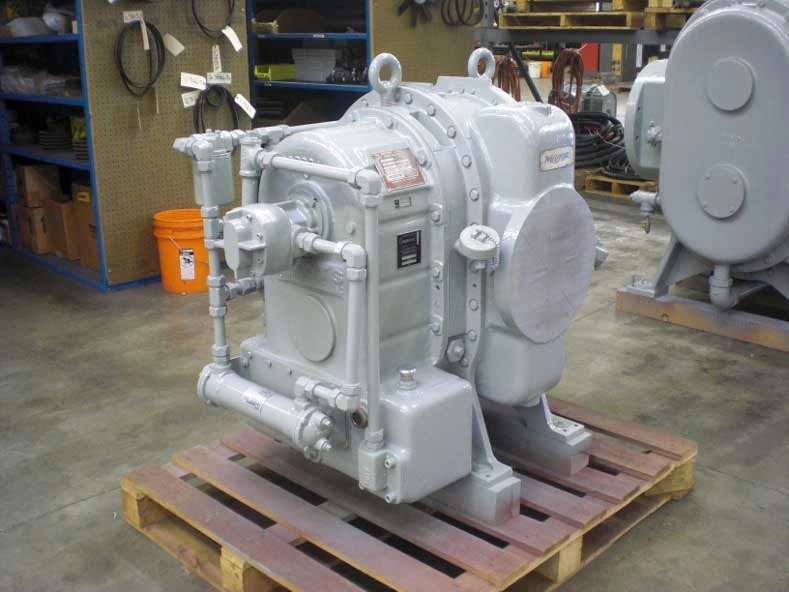
Roots rotary lobe blowers are hard to kill if you keep the right lubricant in them. Change the wrong grade, mix incompatible greases, or run past the change interval and a $12,000 blower turns into a $30,000 rebuild, usually starting with a bearing failure on the drive end.
This guide covers what Howden Roots recommends for URAI, RAM, RCS, and Whispair series rotary lobe blower oil: which oil goes where, which viscosity fits Southern California ambient conditions, which grease belongs on your URAI drive end (it depends on when the blower was built), and how to estimate when you're actually due for a change. Where an item has a matching product on our Roots lubricant catalog, we link directly.
What Roots Lubricates and Where: URAI vs. Everything Else
Roots rotary lobe blowers split into two lubrication designs, and the split determines which reservoirs you service.
URAI series (Universal RAI): grease on the drive end, oil on the gear end. This is the design most small and mid-size Roots blowers use, including URAI, URAI-J (metric), URAI-DSL (dual splash lube), and URAI-G (gas service).
RAM, RAM-J, RCS, RCS-J, and most non-URAI Roots products: oil on both the drive end and the gear end.
Both designs use two separate reservoirs, each with its own sight glass and drain plug. New blowers ship dry, so oil (and grease, if applicable) must be added before the first startup. The URAI grease-on-drive-end design cuts one oil change point but adds a grease service interval. The all-oil design on RAM and RCS blowers uses the same oil in both reservoirs, which simplifies stocking but requires two drains per service.
For a decoder on which model series you're actually running, see our Roots URAI vs. RAM vs. RCS blower model guide.
Which Oil Viscosity to Use in Southern California
Roots specifies oil viscosity based on ambient temperature — the air temperature in the room where the blower actually operates, not the outdoor high. For Southern California mechanical rooms that regularly exceed 90°F in summer, the answer is ISO VG 320.
| Ambient temperature at blower location | Roots-specified viscosity |
|---|---|
| Above 90°F (32°C) | ISO VG 320 |
| 32°F to 90°F (0°C to 32°C) | ISO VG 220 |
| 0°F to 32°F (-18°C to 0°C) | ISO VG 150 |
| Below 0°F (-18°C) | ISO VG 100 |
Roots recommends synthetic oil across every viscosity grade. Petroleum-based oils are compatible with Roots blowers, but service life is roughly one-third that of synthetic (about 2,000 hours at 180°F sump temperature vs. 4,000 to 8,000 hours for synthetic under the same conditions). Synthetic and petroleum blower oils are miscible, so switching over is a drain-and-refill without a flush.
For Southern California ambient conditions, American Compressor Company stocks ISO VG 320 blower oil and Roots Ultra Performance synthetic oil as the two most-used grades.
Which Grease Belongs on Your URAI Drive End (Serial Number Matters)
For URAI drive-end grease, the correct product depends on the build date of your blower. Check the serial number before opening a grease tube.
URAI blowers built August 2016 or later (serial number begins with 1608A or later): use Roots Synthetic Grease, which is purple. Do not mix with any other grease color.
URAI blowers built before August 2016: use Shell Gadus S2 U1000 (NLGI grade 2, Roots PN 71522) or Shell Darina SD 2 (Roots PN 5067628). Both are tan in color. Do not mix with the newer purple synthetic grease.
Mixing tan clay-based grease with the newer purple synthetic grease produces an incompatible mixture that can lose film strength under load, degrade the drive-end bearing, and take the blower with it. If you're switching an older blower to the new synthetic, purge the drive-end reservoir completely first.
American Compressor Company stocks Shell Gadus S2 U1000 for pre-August 2016 Roots URAI drive ends. If you're unsure which grease your unit was factory-filled with, the serial-number check is the fastest confirmation.
How Often to Change Roots Blower Oil
Roots publishes two change intervals for its blower oil: a first-fill interval and an ongoing service interval.
First oil change: 100 hours of operation. This flushes casting and machining debris from the initial factory fill. Skip it and metal particles circulate through the gear mesh and bearings for the life of the oil.
Ongoing service interval: 4,000 to 8,000 hours for synthetic oil at an oil sump temperature of 180°F (82°C). For petroleum-based oil under the same conditions, the interval drops to roughly 2,000 hours.
Oil life is not fixed. It halves for every 15 to 18°F increase in sump temperature above 180°F, and this rule applies to every oil grade Roots specifies. A blower running with a 200°F sump (common in high-vacuum wastewater aeration duty in summer) is on a service interval closer to 2,000 to 4,000 hours for synthetic and around 1,000 hours for petroleum.
How to estimate oil sump temperature without a thermocouple: Roots publishes a field rule of thumb. Multiply the blower discharge temperature by 0.8. A blower discharging at 200°F has an approximate oil sump temperature of 160°F. A blower discharging at 240°F has an oil sump around 192°F, already past the 180°F threshold where change intervals start compressing.
Use a discharge thermometer at the blower discharge silencer (not the header) and take the reading after at least 30 minutes at steady-state operation.
Common Roots Blower Lubrication Mistakes
Five errors show up in field service more than any others.
Using automotive engine oil. Automotive oils contain detergents and additives that Roots blowers do not need and that can attack the seals. Howden Roots explicitly does not recommend automotive lubricants.
Mixing pre- and post-August 2016 URAI grease colors. Purple synthetic and tan clay-based greases are not compatible. Purge the drive end completely when switching between grease families.
Skipping the 100-hour first oil change. New blowers ship dry precisely so this change is required at commissioning. Skipping it circulates factory debris.
Selecting viscosity by outdoor temperature. Roots specifies viscosity by the ambient temperature at the blower location, not the outdoor high. A mechanical room in Compton or Vernon can run 15 to 20°F above the outdoor high in summer.
Overfilling the sump. Excess oil in a Roots reservoir causes churning, foaming, and heat generation, none of which extend service life. Fill to the middle of the sight glass with the blower level and cold.
Ordering Roots Lubricants Through an Authorized Distributor
American Compressor Company stocks the three lubricants covered by Howden Roots' current recommendations for the URAI, RAM, and RCS series.
Shell Gadus S2 U1000: drive-end grease for pre-August 2016 URAI blowers.
ISO VG 320 blower oil: gear-end and combined-end oil for Southern California ambient conditions above 90°F.
Roots Ultra Performance synthetic oil: Roots' recommended synthetic across all viscosity grades and blower models.
Ordering through an authorized Howden Roots distributor confirms two things: the lubricant is the correct Roots-specified product (not a compatible-looking substitute), and the transaction is documented if a warranty question comes up later. Non-authorized substitution is a common cause of warranty denial on early-life bearing failures.
Frequently Asked Questions
Can I use synthetic and petroleum blower oil together in a Roots blower?
Synthetic and petroleum-based blower oils are 100% compatible in Roots rotary lobe blowers, according to Howden Roots' own guidance. You can drain a petroleum fill and refill with Roots Synthetic Oil without a flush. Combining them in the same reservoir works but shortens service intervals closer to the petroleum life curve than the synthetic curve.
What color is Roots synthetic grease, and what happens if I mix it with the older tan grease?
Roots synthetic grease is purple. The older Shell Gadus S2 U1000 and Shell Darina SD 2 greases specified for pre-August 2016 URAI blowers are tan. Mixing purple synthetic with tan clay-based grease produces an incompatible mixture that can lose film strength under load and lead to drive-end bearing failure. When switching a blower over, purge the drive-end reservoir completely before adding the new product.
How often should I change the oil in a Roots URAI blower?
Roots URAI blower oil requires a first change at 100 hours of operation. After that, synthetic oil in the gear-end reservoir lasts 4,000 to 8,000 hours at a 180°F sump temperature; the interval halves for every 15 to 18°F above that threshold. Grease on the drive end should be topped off on a regular schedule based on operating hours, with the exact interval published in the Roots URAI installation, operation and maintenance manual for your specific model. For a walkthrough of the service work itself, see our blower repair services page.
What ISO viscosity oil should I use in a Roots blower in Southern California?
A Roots blower installed in Southern California should typically use ISO VG 320 gear-end oil. Roots specifies viscosity by ambient temperature at the blower location, and most Southern California mechanical rooms exceed the 90°F threshold that triggers the ISO VG 320 recommendation during summer operation. Facilities with well-cooled mechanical rooms staying under 90°F may run ISO VG 220 instead.
Does Roots recommend automotive engine oil for blowers?
Howden Roots does not recommend automotive engine oil for rotary lobe blowers. Automotive oils contain detergents and additives that are not needed for blower service and that can attack the shaft seals over time. Use only lubricants Roots specifies for the URAI, RAM, RCS, or Whispair series.
Southern California Roots Service and Lubricant Supply
Roots rotary lobe blower oil is one of the cheapest components of a blower's total cost of ownership, and it's the one that decides whether the blower runs 100,000 hours or 20,000. Which lubricant, which viscosity, and which change interval come down to three things: model series, ambient temperature at the install site, and actual sump temperature at operating load.
American Compressor Company is an authorized Howden Roots distributor serving Los Angeles County and Southern California from Santa Fe Springs. We stock the three Roots lubricants covered by Howden Roots' current recommendations for URAI, RAM, RCS, and Whispair blowers, and our blower service technicians can pull oil samples, verify sump temperatures, and adjust change intervals against your actual operating conditions. Call 1-800-955-6188 or contact us for lubricant orders or a service assessment.