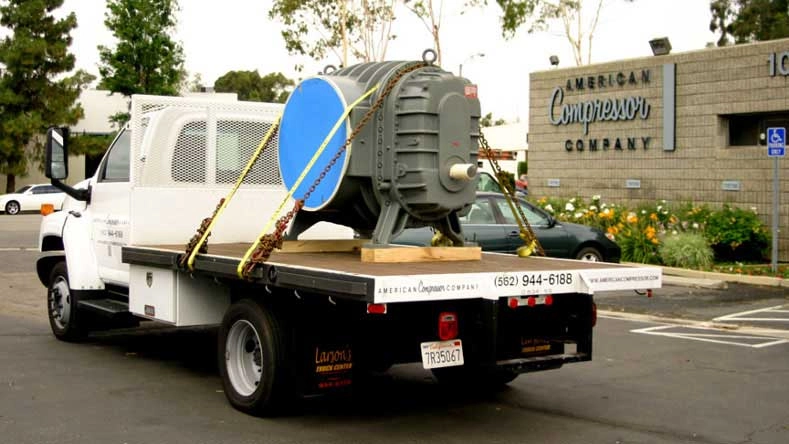
Comparing a Roots URAI vs. RAM blower is not a question of which one is better built. All three of the main Roots rotary lobe series share the same fundamentals: cast or ductile iron construction, bi-lobe impellers, alloy steel timing gears, and positive displacement airflow that stays constant regardless of what the discharge pressure does. What separates them is where each one operates best.
Three numbers decide which series belongs in your application: the pressure you need to overcome, the vacuum you need to pull, and the flow you need to move. Everything else is a configuration detail layered on top. Get those three numbers right and the model selects itself; guess at them and you end up with a blower running at the edge of its curve, which is where bearings and lobes go to die early.
This post lays out the operating envelope for each series, decodes what the model suffixes actually mean, and covers the case most people are really in when they search this: standing in front of a failed unit, trying to figure out what replaces it.
Start With Three Numbers: Pressure, Vacuum, and Flow
A rotary lobe blower is a positive displacement machine. Each rotation traps and moves a fixed volume of air, so the flow it delivers stays essentially constant even as backpressure rises. That behavior is why these units dominate aeration basins and pneumatic conveying lines, where the load changes but the process still needs its air.
It also means the selection math is refreshingly blunt. Your application demands a certain differential pressure (or vacuum), and it demands a certain airflow. If a series tops out below either number, that series is off the table. Here is where the three main Roots lines land, according to Roots' published specifications:
| Model | Max Pressure | Max Vacuum | Max Flow | Typical Role |
|---|---|---|---|---|
| URAI | 15 psig | 16" Hg | 2,460 cfm | General-purpose workhorse |
| URAI-DSL | 15 psig | 16" Hg | 1,740 cfm | Dual splash lubricated |
| RAM | 18 psig | 16" Hg | 3,550 cfm | Higher pressure and flow |
| RAM-DPJ | 30 psig | Not rated | 670 cfm | High pressure, low flow |
| RAM-DVJ | Not rated | 27" Hg | 2,400 cfm | Deep vacuum |
| Tri-RAM | 15 psig | 16" Hg | 5,810 cfm | Highest RAM flow |
| RCS-800 | 18 psig | 16" Hg | 6,300 cfm | Highest capacity |
| RCS-J Whispair | Not rated | 24" Hg | 4,080 cfm | High-flow vacuum |
| RCS-DVJ | Not rated | 27" Hg | 5,260 cfm | Deep vacuum, high flow |
Read that table and most selection debates end quickly. Need 25 psig? Only the DPJ configuration gets there. Need 5,000 cfm? You are in RCS or Tri-RAM territory, and the URAI was never a candidate.
URAI Series: The General-Purpose Workhorse
The Universal RAI series is the line most people picture when they hear "Roots blower." It handles pressures to 15 psig, vacuum to 16 inches of mercury, and flows to 2,460 cfm, built around a one-piece cast iron casing, bi-lobe impellers, and alloy steel timing gears. Roots describes it as a cost-effective design for continuous operation, and that is exactly the job it does.
Its defining practical feature is mounting flexibility. Detachable steel feet allow four drive shaft positions (top, bottom, left, or right), and the unit is center-timed so it can run in either rotation. For a plant retrofitting a blower into an existing skid or piping arrangement, that flexibility often matters more than the spec sheet.
For most municipal aeration basins, pneumatic conveying lines, and industrial vacuum systems operating under 15 psig, the URAI is not a compromise choice. It is the correct one, and stepping up to a heavier series buys capability the application will never use.
RAM Series: More Pressure, More Flow, More Configurations
RAM stands for Reliability, Availability, and Maintainability, which tells you what Roots was optimizing when they designed it. The base RAM reaches 18 psig and 3,550 cfm, meaningfully past the URAI ceiling on both counts, with splash oil lubrication on both ends and die-cast aluminum drive-end and gear covers intended to cut installation cost and simplify service.
Where the RAM line earns its keep is in the specialized J-designated RAM configurations, which stretch the envelope in specific directions rather than uniformly:
- RAM-DPJ: pressures to 30 psig with flow to 670 cfm. This is the high-pressure option, and it trades volume to get there. Dense-phase conveying lives here.
- RAM-DVJ: vacuum to 27 inches of mercury with flow to 2,400 cfm. When the job is pulling deep vacuum rather than pushing pressure, this is the configuration.
- RAM-VJ: vacuum to 24 inches of mercury with flow to 3,550 cfm, for high-flow vacuum duty.
- Tri-RAM: flows to 5,810 cfm at 15 psig, the highest flow in the RAM family.
Notice what the pressure and vacuum variants have in common: each one buys capability in one dimension and gives ground in another. There is no configuration that maxes out pressure, vacuum, and flow simultaneously, which is precisely why the three-number exercise comes first.
RCS Series: Heavy-Duty and Highest Capacity
The RCS line is the heavy end of the catalog: integral-shaft ductile iron impellers with an involute profile, grey iron headplates and casing, and splash oil lubrication at both ends. Roots positions these as heavy-duty units for the most demanding pressure and vacuum service.
The capacity numbers are what set the series apart. The RCS-800 delivers up to 6,300 cfm at 18 psig, the largest flow in the lineup covered here. On the vacuum side, the RCS-J Whispair reaches 24 inches of mercury at 4,080 cfm, and the RCS-DVJ pulls 27 inches of mercury while moving up to 5,260 cfm.
For a large municipal wastewater plant with deep aeration basins, or a facility running high-volume conveying, the RCS is where the flow requirement lands you. For a small package plant or a single conveying line, it is more blower than the process can use, and the operating cost follows the size.
What the Roots Model Suffixes Actually Mean
The letters after the series name are not marketing. Each one designates a specific mechanical configuration, and confusing them is how a plant ends up with a blower that fits the piping but not the duty.
DSL: Dual Splash Lubrication
A URAI-DSL is not a different performance class; it is a URAI with splash oil lubrication on both the gear end and the drive end, rather than grease on the drive end. Roots credits the arrangement with cooler operation and longer gear and bearing life, and notes it supports quieter, smoother running by reducing friction and mechanical noise sources. The pressure and vacuum ratings match the standard URAI, though maximum flow comes in at 1,740 cfm.
DPJ, VJ, and DVJ: Pressure and Vacuum Specialists
The DPJ designation marks the high-pressure configuration, reaching 30 psig on the RAM. VJ and DVJ mark vacuum configurations: VJ pulls to 24 inches of mercury, DVJ to 27 inches. If your nameplate carries one of these suffixes, the unit was selected for a specific duty, and replacing it with a standard model will not reproduce its performance.
J: Whispair
Roots applies the Whispair name to J-designated models such as the RCS-J Whispair, a configuration aimed at demanding vacuum service. If noise is a constraint at your site, the J and DSL configurations are the ones to ask about before you order.
Replacing an Existing Blower? Start at the Nameplate
Most people searching Roots model numbers are not designing a new system. They are looking at a unit that stopped working and need to know what replaces it. If that is you, the selection exercise above is not where to start. The nameplate is.
The frame number on the unit (a 22, a 45, a 68, a 409, a 616, and so on) encodes the physical size and displacement of that blower. Combined with the series and suffix, it tells you exactly what the machine was rated to do. Matching that designation is the fastest path to a drop-in replacement that fits the existing base, coupling, and piping without a redesign.
Two cautions worth raising before you order. First, if the original unit was chronically undersized or oversized for the duty, replacing it like for like reproduces the original mistake, and a quick check of actual operating pressure and flow is worth the delay. Second, a worn blower is not always a dead blower. Rotary lobe units are field-rebuildable, and depending on lobe and casing condition, a rebuild can return the machine to service faster and cheaper than a new one, particularly when lead times are tight.
Frequently Asked Questions About Roots Blower Models
What is the difference between a Roots URAI and a RAM blower?
The difference between a Roots URAI and a RAM blower is the operating envelope. The URAI handles pressures to 15 psig and flows to 2,460 cfm, while the base RAM reaches 18 psig and 3,550 cfm and offers specialized configurations for high pressure (30 psig on the DPJ) and deep vacuum (27 inches of mercury on the DVJ). Both are bi-lobe positive displacement blowers built on the same fundamentals.
What does DSL mean on a Roots blower?
DSL on a Roots blower stands for Dual Splash Lubrication, meaning the unit uses splash oil lubrication on both the gear end and the drive end instead of grease on the drive end. Roots associates the design with cooler operation, longer gear and bearing life, and quieter running. A URAI-DSL carries the same 15 psig and 16 inch Hg ratings as a standard URAI.
Which Roots blower has the highest flow capacity?
The highest flow capacity among these Roots series belongs to the RCS-800, rated up to 6,300 cfm at pressures to 18 psig. The Tri-RAM follows at 5,810 cfm, and the RCS-DVJ moves up to 5,260 cfm in deep vacuum service at 27 inches of mercury.
Which Roots blower is used for wastewater aeration?
Roots blowers used for wastewater aeration are typically selected by basin size and diffuser depth rather than by series name. Smaller plants and package systems commonly run URAI units within the 15 psig envelope, while larger municipal basins with higher airflow demand move into the RAM or RCS series. Discharge pressure is driven by diffuser submergence plus line losses, so the required pressure sets the floor before flow selects the frame.
How do I identify which Roots blower model I have?
To identify which Roots blower model you have, read the nameplate on the unit. It carries the frame number and the series designation, including any suffix such as DSL, J, VJ, DVJ, or DPJ. That combination defines the blower's displacement and its rated pressure, vacuum, and flow, and it is what a supplier needs to quote a matching replacement or a rebuild.
Getting the Blower Right the First Time
The Roots catalog looks complicated from the outside, but the logic underneath it is simple: each series and suffix exists to serve a specific combination of pressure, vacuum, and flow. Once you know your three numbers, the lineup stops being a wall of model codes and becomes a short list. The mistakes happen when the numbers are assumed rather than measured, or when a replacement is ordered off a nameplate that was wrong for the duty in the first place.
American Compressor Company has been a Roots distributor in Los Angeles County since 1961, and we stock, install, service, and rebuild these units across the URAI, RAM, and RCS lines. That means when a wastewater or water treatment plant calls with a blower down, the conversation starts with what the application actually requires rather than with what happens to be in stock.
If you are specifying a new blower, replacing a failed one, or deciding whether the unit in front of you is worth rebuilding, talk to our team and we will size it against your real operating conditions before anyone quotes a model number.