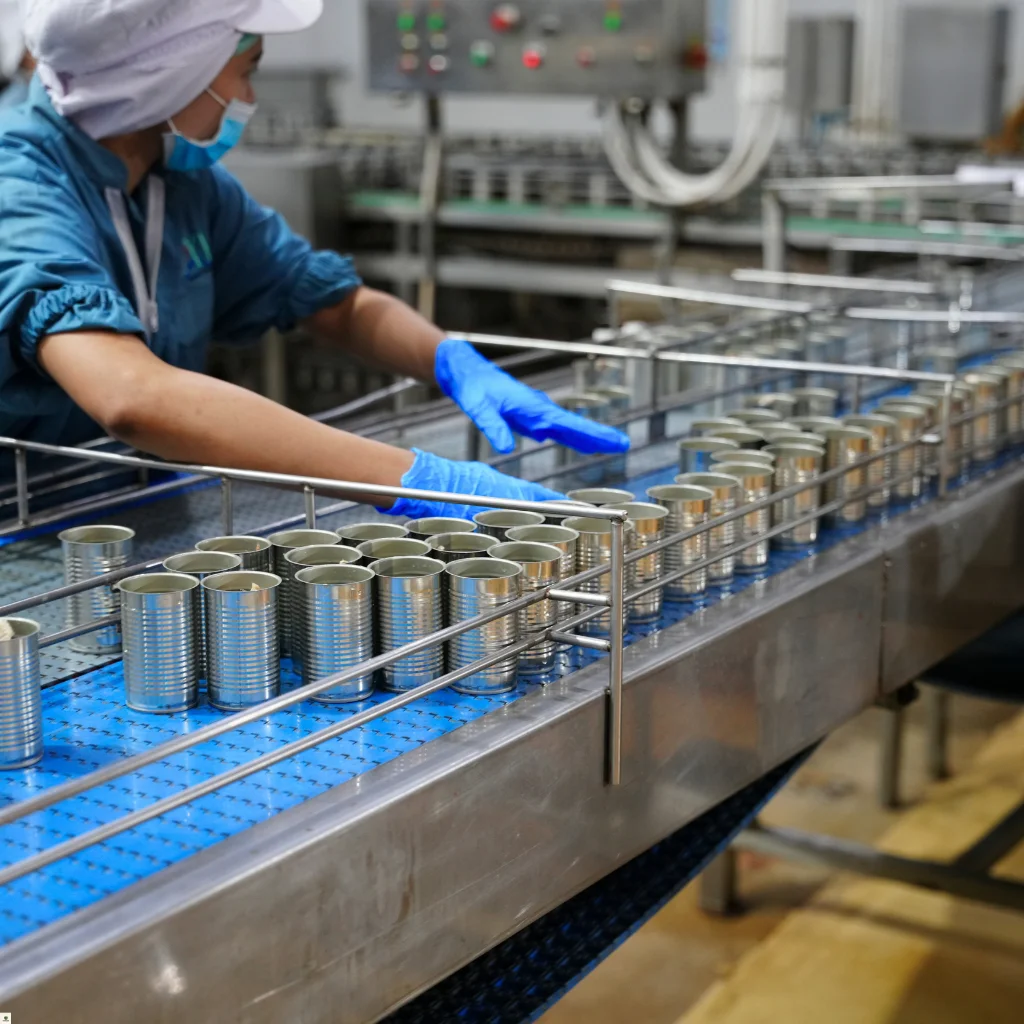
Choosing between a refrigerated vs. desiccant air dryer is not a question of which technology is better. It is a question of how dry your air has to be, and one of the two options is physically incapable of crossing a line the other clears easily. A refrigerated dryer cools compressed air until moisture condenses out. Because water freezes at 32°F, a conventional refrigerated dryer cannot deliver a dew point below freezing. That is not a product limitation. It is the physics of the method.
For a food plant, that single fact often decides the purchase. Air that contacts open product is commonly specified at a dryness level that sits far below anything a refrigerated dryer can reach, while the air running a pneumatic cylinder behind a guard almost never needs to go that low. Buying the wrong one either leaves moisture on your product or spends capital and electricity drying air that never needed it.
This post walks the decision the way an engineer would: start with the dew point your application requires, translate it into an ISO 8573-1 water class, then let that class tell you which dryer technology is on the table.
Dew Point, Not Dryer Type, Is the Real Decision
Pressure dew point is the temperature at which water vapor in your compressed air will condense back into liquid while the system is under pressure. Keep the air in your pipes above that temperature and no water forms. Let any part of the line drop below it, and you get liquid water where your product is.
This is why the coldest point in your system matters more than the average. A line that runs through a chilled packaging room, a cold storage area, or an exterior wall sets the requirement for the whole branch. The Compressed Air and Gas Institute recommends specifying a dew point 20°F below the lowest ambient temperature the air will encounter, precisely to keep that margin intact.
ISO 8573-1 turns dew point into a class number, which is the language dryer manufacturers and auditors both use. The water classes that matter in a plant setting are these:
| ISO 8573-1 Water Class | Maximum Pressure Dew Point | Typically Achieved By |
|---|---|---|
| Class 1 | -94°F (-70°C) | Desiccant dryer, modified for low dew point |
| Class 2 | -40°F (-40°C) | Regenerative desiccant dryer |
| Class 3 | -4°F (-20°C) | Desiccant dryer |
| Class 4 | +37.4°F (+3°C) | Refrigerated dryer |
| Class 5 | +44.6°F (+7°C) | Refrigerated dryer |
| Class 6 | +50°F (+10°C) | Refrigerated dryer |
Read the table from the right and the decision resolves itself. Everything at or below freezing belongs to desiccant. Everything above it belongs to refrigerated. There is no overlap to argue about.
What a Refrigerated Air Dryer Can and Cannot Do
A refrigerated dryer works like a household refrigerator: it chills the compressed air to roughly 35°F to 50°F, condenses the moisture out, drains it away, and reheats the air on the way out. CAGI lists typical pressure dew points for refrigerant-type dryers at 38°F to 50°F, which places them in ISO water Class 4 through Class 6.
Within that range, refrigerated dryers are the pragmatic choice, and they are the most widely used dryer type in industry for good reason. Capital cost is low. Operating and maintenance costs are low. They tolerate oil in the air stream, which matters on a lubricated rotary screw compressor. For plant air, tool air, and enclosed pneumatic actuation, they do the job without drama.
The hard limit is the freezing point. Since condensate would turn to ice inside the heat exchanger below 32°F, a conventional refrigerated dryer cannot produce a sub-freezing dew point. No amount of oversizing changes that. If your specification calls for Class 2 water at -40°F, a refrigerated dryer is not a cheaper way to get there; it is not a way to get there at all.
What a Desiccant Air Dryer Delivers, and What It Costs to Run
A regenerative desiccant dryer takes a different approach: instead of chilling the air, it passes it through a bed of desiccant beads that adsorb water vapor directly. Two towers alternate, one drying while the other regenerates. CAGI puts typical regenerative desiccant performance at -40°F, with dew points as low as -100°F achievable through changes to purge volume, desiccant material, and cycle timing. That is ISO water Class 2, and at the low end, Class 1.
The dryness is real, and so is the bill. In a heatless desiccant dryer, regeneration is driven by expanding already-compressed air across the offline bed, and that purge air can consume up to 18 percent of the dryer's rated flow. Air you paid to compress is vented to the atmosphere. Heat-reactivated designs cut the purge requirement to roughly 5 to 10 percent by applying heat instead, trading purge air for heater energy.
Two other costs belong in the comparison. Desiccant beds need periodic replacement, typically every three to five years. And desiccant is vulnerable in a way refrigerated dryers are not: oil aerosol coats the beads and destroys their ability to adsorb water. Every desiccant dryer needs a coalescing pre-filter protecting it, plus a particulate filter downstream to catch desiccant fines. On a lubricated compressor, that filtration is not optional, and skipping it is the fastest way to ruin a new desiccant bed.
Matching the Dryer to a Food Plant's Actual Air Requirements
Food and beverage specifications frequently reference ISO 8573-1 Class 1.2.1: Class 1 particles, Class 2 water, Class 1 oil. Look back at the water table and the implication is immediate. Class 2 water means -40°F, so a Class 1.2.1 target requires a desiccant dryer. CAGI's own treatment layouts confirm the arrangement: a regenerative desiccant dryer at -40°F, protected by a high-efficiency coalescing filter, followed by a particulate filter and an activated carbon filter, produces Class 1.2.1 air. Substitute a refrigerated dryer into the same arrangement and the result is Class 1.4.1, clean on oil and particles but four classes off on water.
Class 1.2.1 is a widely used benchmark, not a legal mandate. Neither the FDA nor the food safety schemes name a required ISO class; the target comes from your own risk assessment at each point of use. That distinction is what saves money, because CAGI is direct on the other side of the ledger: specifying a dew point lower than the application needs raises both capital and operating cost and is not good engineering practice.
Which points to the architecture most food plants should actually consider. Drying the entire plant to -40°F to satisfy one product-contact line means paying the desiccant purge penalty on every cubic foot of air the facility uses, including the air running door actuators and case packers. The alternative is to dry the plant with a refrigerated dryer and install a smaller desiccant dryer at the point of use where product-contact air is drawn. Same air quality where it counts, a fraction of the purge loss.
The right answer depends on how much of your total demand is product-contact air, how your piping is zoned, and how cold the coldest run gets. Those are facts about your plant, not about the dryers, which is why the decision starts with a look at the system rather than a spec sheet.
Frequently Asked Questions About Refrigerated and Desiccant Air Dryers
What is the difference between a refrigerated and a desiccant air dryer?
The difference between a refrigerated and a desiccant air dryer is the drying method and the dew point each can reach. A refrigerated dryer chills compressed air to condense moisture out and delivers a pressure dew point around 38°F to 50°F, while a desiccant dryer adsorbs water vapor onto a desiccant bed and reaches -40°F or lower. Refrigerated units cost less to buy and run; desiccant units deliver far drier air.
Can a refrigerated air dryer reach a -40°F dew point?
A refrigerated air dryer cannot reach a -40°F dew point. Because the technology removes water by cooling it until it condenses, and condensate would freeze inside the dryer below 32°F, a conventional refrigerated dryer cannot deliver a sub-freezing dew point at all. Applications requiring -40°F need a desiccant dryer.
What dew point does a food processing plant need for compressed air?
The dew point a food processing plant needs is set by a risk assessment at each point of use, not by a single regulation. Air that contacts open product is commonly specified at ISO 8573-1 Class 2 water, meaning -40°F, while enclosed pneumatic air often runs safely on Class 4, around +37°F. The coldest ambient temperature the line passes through also drives the requirement.
Why do desiccant dryers cost more to operate?
Desiccant dryers cost more to operate because regenerating the desiccant bed consumes compressed air or energy. A heatless design uses up to 18 percent of its rated flow as purge air that is vented to the atmosphere, and heat-reactivated designs cut that to roughly 5 to 10 percent by adding heater energy instead. Desiccant beds also need replacing every three to five years.
Does a desiccant dryer need a filter in front of it?
A desiccant dryer needs a coalescing filter in front of it, because oil aerosol coats the desiccant beads and destroys their ability to adsorb moisture. A particulate filter is also required downstream to capture desiccant fines before they travel into the plant. On a lubricated compressor, this filtration protects the investment in the dryer itself.
Sizing The Dryer To The Plant's Spec Sheet
The dryer debate usually gets framed as a product comparison when it is really a systems question. Dew point requirements come from your coldest line and your most sensitive point of use. Purge losses come from how much air you push through a desiccant bed that most of your plant never needed. Get those two facts right and the dryer selects itself; get them wrong and you either contaminate the product or pay to over-dry air for the next fifteen years.
American Compressor Company has been sizing compressed air systems for Los Angeles food and beverage plants since 1961, and we supply both refrigerated and desiccant Kaeser dryers along with the filtration each one requires. That means the recommendation you get is driven by your air demand and your point-of-use requirements rather than by whatever is on the truck.
If you are specifying a dryer, replacing one, or suspect you are drying more air than your process actually needs, schedule an air systems analysis and we will map your dew point requirements point by point before anyone quotes a unit.