The most common equipment decision in industrial compressed air is also one of the most frequently misunderstood: rotary screw or reciprocating compressor? For buyers who have not been through this decision recently, or who are setting up a new facility, the choice can feel like a coin flip between two machines that both make compressed air.
They are not interchangeable. The two technologies work differently, age differently, cost differently to maintain, and are suited to fundamentally different operating profiles. Choosing the wrong one for your facility does not just cost money upfront — it costs money every day the machine runs at the wrong duty cycle, and it shows up as maintenance spend and downtime over the life of the equipment.
This guide lays out the comparison directly, covers the scenarios where each technology is the right answer, and gives LA County manufacturers the information they need to make the decision confidently.
How Each Technology Works
Understanding the comparison starts with understanding how the two machines actually produce compressed air, because the mechanical difference explains most of the performance differences that follow.
Rotary Screw Compressors
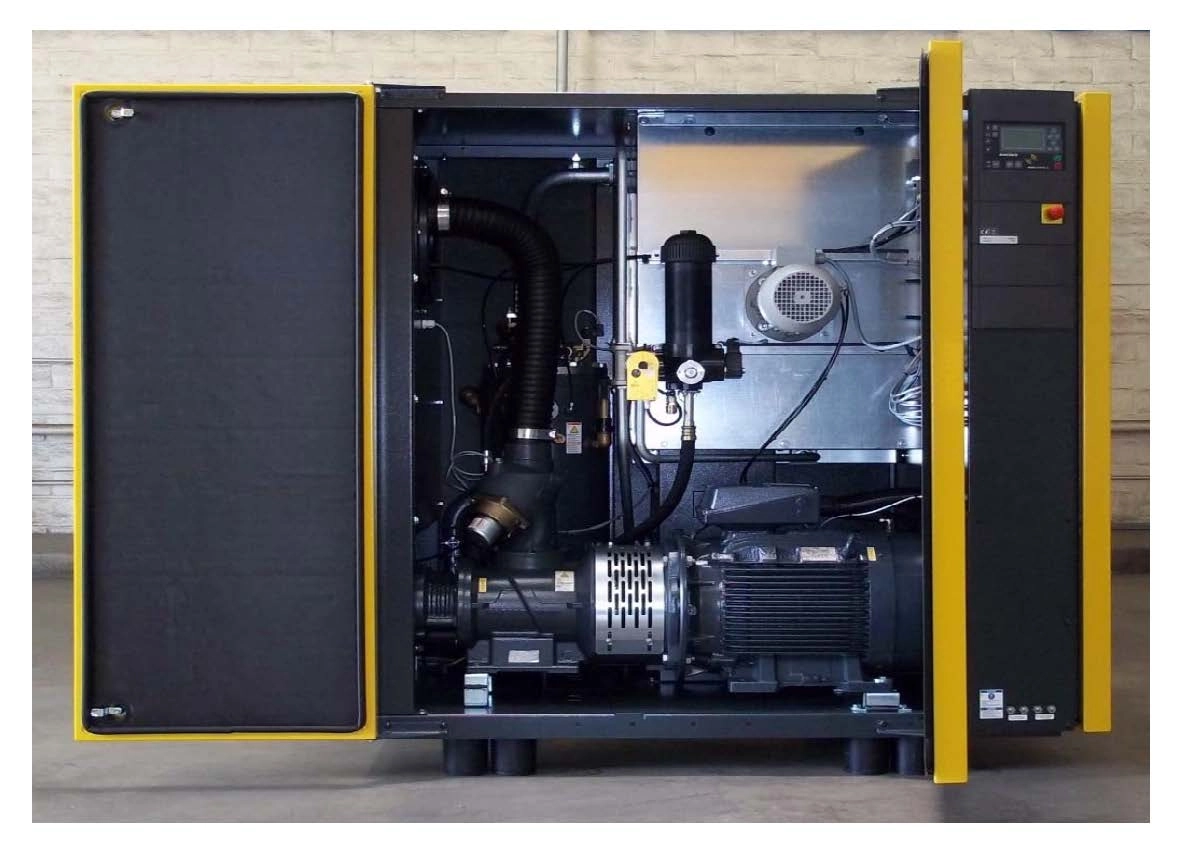
A rotary screw compressor compresses air using two intermeshing helical rotors spinning in opposite directions inside a precision-machined housing. Air enters at one end, gets trapped between the rotor lobes, and is progressively compressed as the rotor profile reduces the available space. The compressed air exits continuously at the discharge end.
In oil-flooded rotary screw machines, the most common type in industrial environments, oil is injected directly into the compression chamber. It serves three simultaneous functions: cooling the air during compression (which allows the machine to run continuously without overheating), sealing the clearance between the rotors (which improves volumetric efficiency), and lubricating the rotor bearings. The oil is separated from the compressed air downstream before delivery to the system.
The result is a machine that produces a smooth, continuous, pulsation-free air supply and is designed to run at full duty cycle indefinitely. There is no mechanical reason a well-maintained rotary screw compressor cannot run 24 hours a day, 365 days a year.
Reciprocating (Piston) Compressors
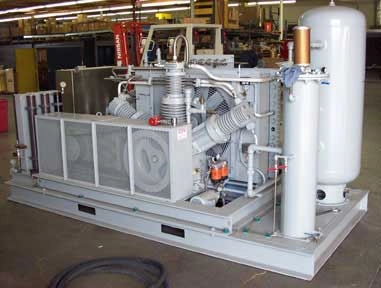
A reciprocating compressor uses a crankshaft-driven piston moving inside a cylinder to compress air. On the intake stroke, the piston moves down and draws air through an intake valve. On the compression stroke, the piston moves up, closes the intake valve, and compresses the air until it reaches the discharge pressure, at which point the discharge valve opens and the compressed air exits.
This is an intermittent mechanical process: compression happens in discrete strokes rather than continuously. Most reciprocating compressors deliver air with noticeable pulsation, which is why they are typically used with receiver tanks that buffer the pulsation before air enters the distribution system.
Reciprocating compressors are duty-cycle limited. Manufacturers rate them for a maximum percentage of on-time versus off-time: a compressor rated at 50% duty cycle should not run more than 30 minutes out of every hour. Exceeding the rated duty cycle accelerates wear on pistons, rings, valves, and bearings, and reduces service life significantly.
Side-by-Side Comparison
Here is how the two technologies compare across the factors that matter most to industrial buyers in LA County.
| Factor | Rotary Screw | Reciprocating (Piston) |
|---|---|---|
| Duty cycle | 100% continuous duty — designed to run without stopping | Typically 50–75% rated duty cycle; exceeding it accelerates wear |
| Air delivery | Smooth, continuous, pulsation-free | Pulsating; receiver tank required to buffer |
| Operating noise | 60–75 dB (quieter; typically enclosed in a sound-dampened cabinet) | 80–90+ dB (louder; open piston design) |
| Energy efficiency at full load | High specific power; Kaeser Sigma Profile rotors among most efficient available | Comparable to rotary screw at full load in some ranges |
| Energy efficiency at part load | Excellent with VFD; good with modulation on fixed-speed | Poor; pistons run at fixed speed regardless of demand |
| Maintenance complexity | Lower; fewer moving parts, oil-based lubrication simplifies service | Higher; pistons, rings, valves, and connecting rods all require periodic service |
| Maintenance interval | Every 2,000–4,000 hours (oil and filter changes, separator element) | Every 500–1,000 hours for valve and ring inspection in continuous use |
| Initial purchase cost | Higher (25–50 HP rotary screw costs more than equivalent reciprocating) | Lower upfront cost at equivalent output in smaller HP ranges |
| Total cost of ownership | Lower over 10–20 year life in continuous-duty applications | Can be lower in light-duty, intermittent applications |
| Footprint | Compact; most units are self-contained packages with integrated dryer options | Larger relative to output at equivalent HP in industrial configurations |
| Service life | 15–20+ years with proper maintenance | 10–15 years in standard industrial use; less in continuous-duty |
| Best HP range | 5 HP to 500+ HP; full industrial range | 1 HP to 30 HP for standard industrial; specialty models up to 100+ HP |
Where Rotary Screw Compressors Win
For the majority of LA County manufacturing, fabrication, and industrial facility applications, rotary screw compressors are the right choice. The reasons come down to duty cycle, maintenance burden, and operating cost over the machine's life.
Continuous and Multi-Shift Operations
Any facility running compressed air for two or more shifts per day, or running processes that require continuous air supply, should be on a rotary screw compressor. A reciprocating machine running at or near its duty cycle limit in this environment will require significantly more frequent valve and ring service, will run hotter than designed, and will accumulate wear faster than the manufacturer's service intervals account for.
LA County's manufacturing corridor includes a high concentration of facilities running multi-shift operations: food processing plants running continuous production lines, automotive shops with back-to-back work orders, machining centers with CNC equipment that need stable air pressure across full production days. For all of these, a rotary screw is typically the correct system.
Applications Requiring Stable Pressure
Rotary screw compressors deliver air continuously without the pressure pulses that characterize reciprocating machines. For applications sensitive to pressure variation, including CNC toolchangers, spray finishing equipment, and pneumatic measurement instruments, the smooth delivery of a rotary screw machine reduces equipment wear and improves process consistency.
A receiver tank can buffer the pulsation from a reciprocating compressor, but it adds cost, space, and a maintenance item to the installation. A rotary screw machine delivers stable pressure natively.
Noise-Sensitive Environments
Rotary screw compressors are substantially quieter than reciprocating machines at equivalent output. Most modern rotary screw packages, including Kaeser's full product line, enclose the compression system in a sound-dampened cabinet that brings operating noise to 60–75 dB. A reciprocating compressor in the same HP range runs at 80–90+ dB in an open frame configuration.
For facilities where the compressor is located near production staff, offices, or customer-facing areas, that noise difference is significant. LA County's municipal noise ordinances and OSHA occupational noise exposure limits are relevant considerations for facilities evaluating compressor placement.
Variable Demand with a VFD Unit
For facilities with genuinely variable compressed air demand across the production day — processes that ramp up and down, shift changes that alter load, or seasonal production variation — a VFD rotary screw compressor captures energy savings that a reciprocating machine cannot. The VFD adjusts motor speed to match output precisely to demand; a reciprocating compressor has no equivalent mechanism.
Southern California Edison's industrial electricity rates make this calculation particularly relevant for LA facilities. The DOE estimates VFD compressors reduce energy consumption by 35–50% in variable-demand applications compared to fixed-speed alternatives. At SoCal Edison commercial and industrial rates, that translates to meaningful annual savings that offset the VFD's higher upfront cost within a few years. If you are unsure of your demand profile, an air systems analysis measures actual consumption before specifying equipment.
Where Reciprocating Compressors Are Still the Right Answer
Reciprocating compressors are not obsolete technology. There are specific applications and operating profiles where they remain the correct choice, and a good service provider will tell you so honestly rather than defaulting to a higher-margin rotary screw sale.
Genuinely Intermittent, Low-Volume Demand
A small shop that runs two or three pneumatic tools for a few hours a day, with long idle periods between uses, does not need a rotary screw compressor. A reciprocating machine sized appropriately for that intermittent demand is a cost-effective, serviceable solution. The calculus changes when that shop adds staff, adds processes, or extends its operating hours.
High-Pressure Applications
Standard rotary screw compressors are designed for operating pressures in the 100–200 PSI range. Applications requiring pressures above that range, including some testing equipment, PET bottle blowing, and specialty industrial processes, require either a multi-stage reciprocating compressor or a dedicated high-pressure compressor. Rotary screw technology has limits at the high end of the pressure range that reciprocating machines do not share.
Backup and Redundancy
A reciprocating compressor can serve effectively as standby backup capacity for a facility whose primary system is a rotary screw installation. In the event of a primary compressor failure, the reciprocating backup provides at least partial air supply to keep critical processes running. For this application, the reciprocating machine's lower cost and simplicity are advantages rather than limitations.
Budget-Constrained Entry-Level Installations
For a new business or a facility setting up compressed air for the first time with genuinely limited budget and modest demand, a reciprocating compressor may be the right starting point with a clear upgrade path. The key is being honest about the upgrade trigger: if and when demand becomes continuous, the reciprocating machine should be replaced, not pushed past its design limits.
The Total Cost of Ownership Calculation
The purchase price comparison between rotary screw and reciprocating compressors is straightforward: reciprocating machines cost less upfront in equivalent HP ranges. The total cost of ownership comparison over a 10–15 year horizon is where the picture changes for most industrial buyers.
Consider a facility running compressed air for two shifts per day, 250 days per year. A 25 HP reciprocating compressor running at or near its rated duty cycle in this scenario will require valve and ring service every 12–18 months, has a realistic service life of 10–12 years in continuous use, and runs at a fixed speed regardless of whether demand is 20% or 100% of capacity.
A 25 HP Kaeser rotary screw compressor in the same application runs preventive maintenance every 2,000–4,000 hours, has a design life of 15–20 years, and with a VFD option can reduce energy consumption significantly during low-demand periods. Energy cost, which the DOE's Compressed Air Challenge estimates accounts for 70–80% of a compressor's lifetime cost, runs lower on a properly maintained rotary screw machine in continuous duty.
The crossover point where rotary screw total cost of ownership becomes lower than reciprocating typically occurs somewhere in the 3–5 year range for facilities running two or more shifts. For facilities running one shift with genuine idle time, the crossover may not occur within the machine's service life. The right answer depends on the actual operating profile of the specific facility.
Frequently Asked Questions
Can I convert my reciprocating compressor setup to a rotary screw system?
Yes, and it is a common upgrade path for facilities that started with a reciprocating machine and have grown into continuous-duty demand. The primary considerations are electrical service (rotary screw machines require appropriate motor starter or VFD panel), the existing distribution system (pressure and flow characteristics should be evaluated for compatibility with the new machine's output), and whether any downstream equipment has pulsation buffers that were necessary with the reciprocating machine and are now redundant. Our compressor installation team handles the full conversion.
Is a rotary screw compressor harder to maintain than a reciprocating one?
No, and in continuous-duty applications it is substantially easier. Rotary screw compressors have fewer moving parts than reciprocating machines: no pistons, no connecting rods, no intake and discharge valves that cycle on every stroke. The primary consumables are oil, filters, and a separator element, all of which are replaced on a defined interval. Reciprocating compressors require more frequent valve and ring inspection in continuous use and have more wear items to track.
What size rotary screw compressor do I need to replace my existing reciprocating unit?
Do not size the replacement based on the existing machine's HP rating alone. Reciprocating and rotary screw compressors have different volumetric efficiencies, and a direct HP-for-HP swap may produce more or less CFM than your facility requires. The correct approach is to measure your facility's actual demand in CFM at the required pressure, add a 20–25% buffer for leaks and future growth, and select a rotary screw machine rated for that output. A compressed air systems specialist can conduct a formal demand analysis if you do not have reliable consumption data.
Do rotary screw compressors need a receiver tank?
Rotary screw compressors produce a continuous, non-pulsating air supply and do not require a receiver tank for pressure buffering the way reciprocating machines do. However, a properly sized receiver tank is still recommended downstream of a rotary screw installation to handle demand spikes that exceed the compressor's instantaneous output, to provide a short-term air reserve during machine startup, and to reduce compressor cycling frequency in lightly loaded VFD systems. The tank is not required; it is a good system design.
What about oil-free rotary screw compressors?
Oil-free rotary screw compressors exist and are the correct choice for applications where any trace oil contamination in the compressed air is unacceptable: pharmaceutical manufacturing, food contact applications requiring Class 0 air, semiconductor fabrication, and certain medical equipment. They are more expensive to purchase and maintain than oil-flooded machines, and they are not necessary for most industrial applications where downstream filtration can achieve the required air quality. If your application requires oil-free air, that requirement should drive the specification; do not default to oil-free equipment without confirming the air quality standard actually required by your process.
Making the Right Call for Your LA Facility
For most manufacturing and industrial facilities in Los Angeles County, the answer is a rotary screw compressor. Continuous duty, lower maintenance burden, quieter operation, and the ability to match output to demand with a VFD unit make rotary screw the right technology for the majority of industrial applications. The higher upfront cost is recovered through lower energy spend, less maintenance labor, and a longer service life.
Reciprocating compressors remain the right choice for genuinely intermittent, low-volume applications and specific high-pressure requirements. If your operation is small and your air demand is truly intermittent, a reciprocating machine is a cost-effective starting point.
American Compressor Company has been helping LA County manufacturers and industrial facilities select, install, and service compressed air systems since 1961. We are an authorized Kaeser dealer and carry both rotary screw and specialty compressor lines. We will give you a direct recommendation based on your facility's actual needs, not the product with the highest margin.
Call us or contact us to schedule a site consultation. We serve facilities throughout LA County, including Santa Fe Springs, Los Angeles, Long Beach, Torrance, Downey, Carson, and the surrounding cities and areas.