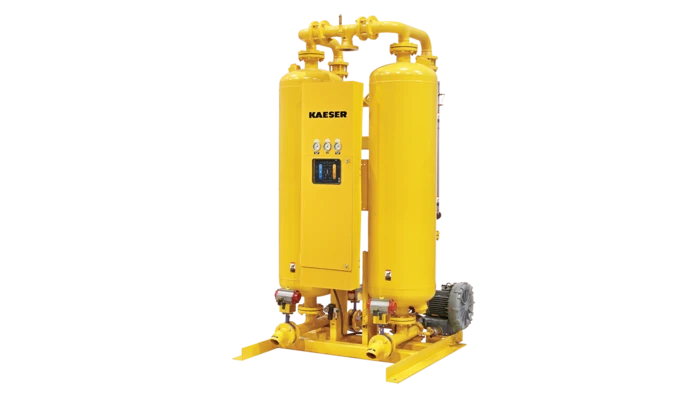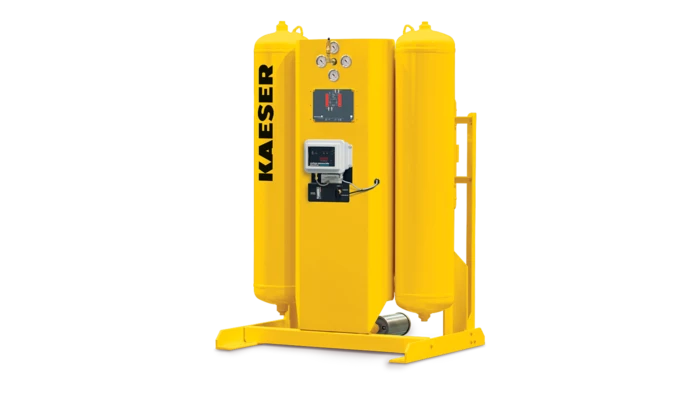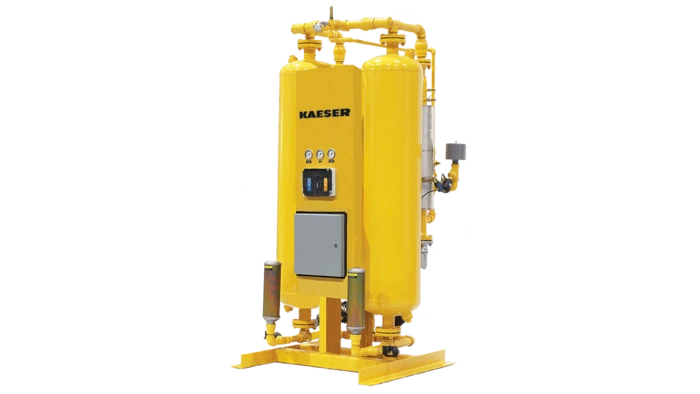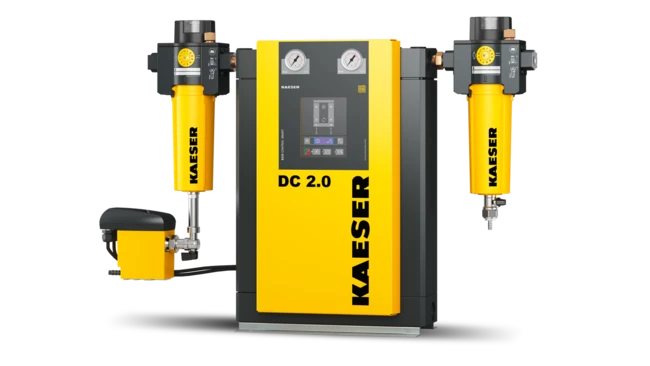
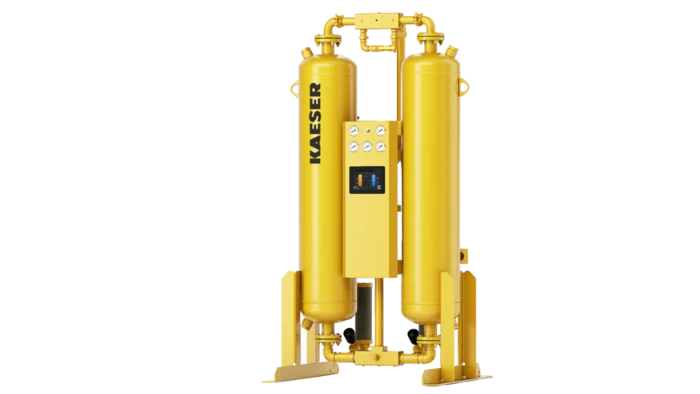
KAD, KED, and KBD Series
Heatless Regenerated Desiccant Dryers, up to 5400 scfm
- 40 to 5400 cfm
Desiccant Air Dryers The right dryer for you Most compressed air applications can achieve the required air quality by using a refrigerated dryer in combination with proper filtration. For those cases where compressed air is exposed to freezing tempe…
Service & Support for Heatless Regenerated Desiccant Dryers, up to 5400 scfm
American Compressor Company sells, services, repairs, and supports Dryers across Los Angeles County and Southern California.
Desiccant Air Dryers The right dryer for you Most compressed air applications can achieve the required air quality by using a refrigerated dryer in combination with proper filtration. For those cases where compressed air is exposed to freezing temperatures or where the product, process, or equipment is highly sensitive to moisture, KAESER offers a complete line of desiccant dryers specifically designed to meet low dew points and deliver energy savings. Innovation you can trust Savings with proper application With a cutting edge research and development team committed Desiccant dryers have a higher purchase price and operating to building industry-leading products, KAESER continues to costs than refrigerated dryers and should be applied to the deliver better solutions to meet our customers’ compressed air portions of a system requiring low dew points.
Our system design needs. KAESER’s expertise and world-wide reputation for superior team will help you size and select the dryer to deliver air quality reliability and efficiency offer great performance and peace of suitable for you application with the lowest life cycle costs. mind.
Quality in every detail The benefits of counterflow regeneration Desiccant dryer performance and reliability are driven by Regardless of design, liquid water will accumulate in the piping component quality. KAESER’s valves and actuators are designed between the prefilters and the dryer inlet. Eventually, the air stream for consistent dew point performance and low pressure drop.
will carry a “slug” of water into the desiccant bed. With the inlet at the bottom of the tower, our upflow drying design minimizes the Additionally, desiccant bed symmetry is selected to ensure accumulation of liquid water in the desiccant beds. uniform flow distribution and maximize contact time, while the spherical activated alumina desiccant allows for long service life Counterflow design ensures that the driest portion of the and minimizes dusting.
A high surface-to-volume ratio and great desiccant bed is nearest the dryer outlet at switchover, and allows affinity for water vapor yield superior adsorption. purge air to be evenly distributed throughout the desiccant bed, providing more effective regeneration. Desiccant dryer basic operation Dryer Outlet KAESER desiccant dryers use the principles of adsorption and desorption and alternately 2 cycle the compressed air through twin desiccant towers.
As the vapor-laden air flows through one tower, the moisture is adsorbed onto the desiccant. Meanwhile, in the other tower, “purge air” flows through, evaporates the water off the desiccant, and carries it out of the tower as vapor. The process starts with the air entering the inlet switching valve (1) which diverts the air A 3 B into the drying tower (A).
The tower, filled with desiccant, adsorbs the water from the 1 compressed air. The air then exits the dryer through the outlet switching valve (2). Air is also diverted through the purge line, reduced in pressure by orifices and the purge adjusting valve (3), to the regenerating tower (B), and out the dryer through the purge valve (4).
This stream of air is the purge air that sweeps the moisture off the spent desiccant so it can be used again. The towers then switch and the operation continues to dry the air and regenerate the desiccant bed. 4 Inlet and Purge Valves 2
Documentation
Datasheets and product literature for Heatless Regenerated Desiccant Dryers, up to 5400 scfm.