Quick Takeaway
Primary Insight: When a rotary screw compressor shuts down mid-shift, the first hour of operator actions determines whether you're facing a two-hour repair or a two-day rebuild.
Key Fact: Unplanned compressed air outages cost manufacturers between $30,000 and $260,000 per hour in lost production, according to industry research cited by Kaeser.
Best Suited For: Plant maintenance leads, shift supervisors, and operations managers responsible for compressed air uptime in Southern California facilities.
A rotary screw compressor rarely fails without warning. It flashes a fault code, cycles power, or trips a breaker before it stops making air. What you do in the first hour after that trip decides whether your production line is down for two hours or two days.
Unplanned compressed air outages cost manufacturers between $30,000 and $260,000 per hour in lost production, according to industry research (Aberdeen and Stratus) cited by Kaeser. The service call itself is a small portion of that number. Everything else is the shift that stopped, the material spoiling in a mixer, or the coating booth losing atomization pressure.
This is a dealer's field guide to what matters in the first hour when compressor down service is what you actually need. It covers what to check, what you can safely fix yourself, when to stop trying, and exactly what to tell a service dispatcher so a technician arrives with the right parts on the truck. If you already know you need help, call emergency service and skip to the call script below.
Safety First: Three Situations Where You Stop and Evacuate
Before you touch anything, rule out three failure modes that turn a compressor call into a fire or medical call.
1. Smoke or oil fire from the enclosure
Shut down at the disconnect only if you can reach it without being in the smoke path. Do not attempt to fight an oil fire with water. Evacuate and call the fire department. Compressed-air lubricant fires are Class B fires and require a dry-chemical or CO₂ extinguisher.
2. Burning-electrical smell, or a breaker that trips again immediately after reset
Isolate power at the disconnect and do not re-close the breaker. A short in the motor windings or contactor stack will keep tripping and can arc-flash a technician who resets it a fourth time.
3. Refrigerant or unusual gas odor near a refrigerated dryer
Evacuate the mechanical room and ventilate. Compressed-air refrigeration circuits use small refrigerant charges, but a leaking system near operators is a health call, not a compressor call.
Anything short of those three is a compressor problem, not an emergency. Proceed.
First 15 Minutes: Isolate, Observe, and Document the Fault
The first 15 minutes are about protecting the machine from secondary damage and preserving evidence for the technician.
Stop the machine using the E-stop, not the disconnect, unless a safety condition requires cutting power. E-stop keeps the control system alive so fault codes remain visible.
Isolate the compressor from the plant by closing the discharge shutoff valve. Downstream demand will drop the header pressure and put load on any backup unit.
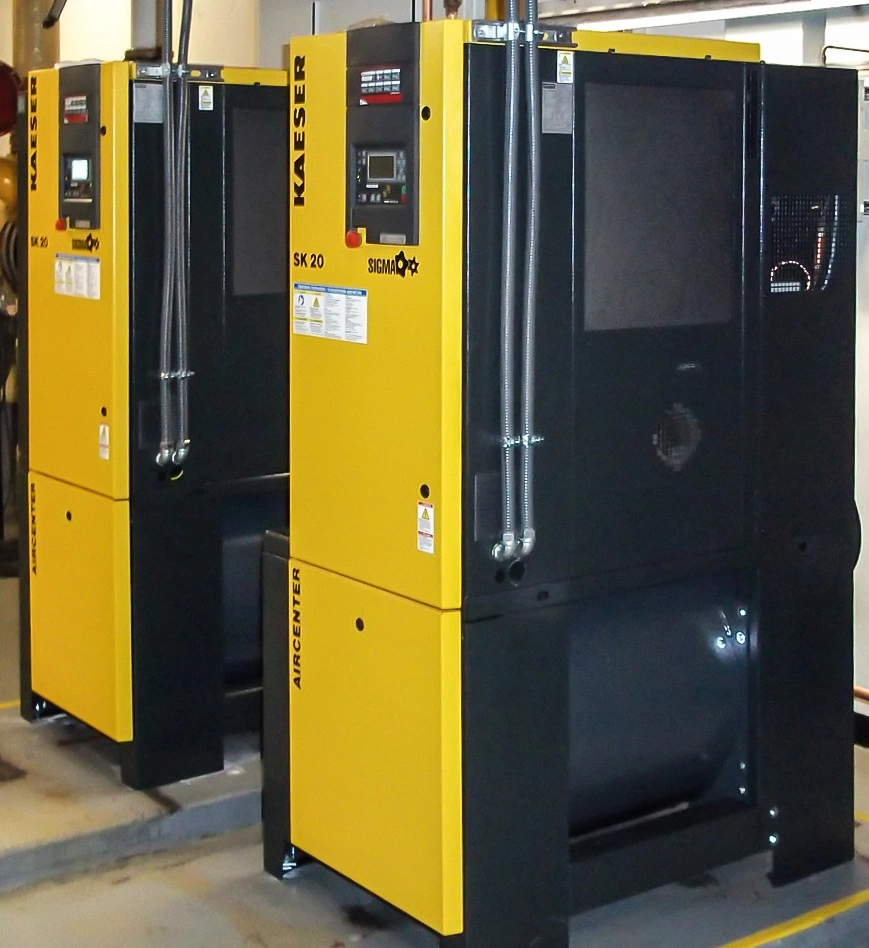
Photograph the controller display before touching anything. Kaeser SIGMA CONTROL 2 units show a fault message with a code (for example, 0004 for E-stop actuated, 0043 for airend discharge temperature rate rise, 0102 for cooler fan overcurrent, or the 0200-series for variable-frequency-drive faults). A photo of the exact message speeds diagnosis significantly.
Note what happened right before the shutdown: the last pressure reading, whether the unit was in load or idle, any unusual noise, any recent maintenance activity, and whether other equipment on the same electrical panel tripped.
Do not reset the fault yet. Reset clears the memory of what shut the machine down. That decision belongs to the technician on the phone.
Quick Fixes That Get You Running Again in 30 Minutes
Several common shutdown causes are operator-resolvable and won't put a rebuild on your calendar. Only attempt these if the fault message and machine condition clearly point to one of them.
| Fault indication | Likely cause | Operator action |
|---|---|---|
| E-stop pressed accidentally (Code 0004 on SIGMA CONTROL 2) | E-stop button latched | Rotate the E-stop button in the arrow direction to release, then press Reset. Restart per manual. |
| Overtemperature trip after long run in high ambient | Cooler dust load, blocked airflow, or low oil | Let the machine cool 30 minutes. Check cooler face for lint or dust. Verify oil level in the sight glass. Restart. |
| No pressure buildup (Code 0044) | Large downstream leak or open bypass valve | Walk the piping. Close any recently opened bypass or blow-off valve. Look for a failed condensate drain stuck open. |
| Emergency overpressure trip | PRV lifted after control failed to unload | Do not reset repeatedly. Look for a stuck load solenoid or blocked pressure sensor line. If the PRV is now leaking, call for service. |
| Motor overload trip (thermal overload) | Voltage sag, dirty motor, or tight airend | Verify facility voltage is within nameplate. Check for a starting attempt during a brownout. If it trips a second time after reset, call for service. |
If the fault message does not match one of these five cases, do not keep resetting the alarm. Repeated restarts against an active fault are how a $2,000 sensor problem becomes a $25,000 airend replacement.
Signs You Should Stop Troubleshooting and Call for Service
Five signals mean the compressor needs a technician, not another restart.
Grinding, knocking, or metallic clicking from the airend. The airend is the most expensive single component in the compressor. Running it through a bearing failure destroys the airend and often the motor with it.
Oil visible in the discharge line, dryer, or wet receiver. Oil carryover past the separator points to a failed separator element, a ruptured element, or a scavenge line problem. Continuing to run contaminates downstream filters and any air tools or products at the point of use.
Motor hums but does not turn, or turns slowly. Locked airend, seized motor bearing, or a single-phased motor. Attempting another start will burn the motor.
Repeated overtemperature trips after a full cool-down. Coolant flow problem, blocked airend passages, or a failed thermostatic valve. Each restart risks a hot airend seizure.
Airend discharge temperature rate-of-rise alarm (Code 0043 on SIGMA CONTROL 2). The controller has detected the ADT climbing faster than it should. This is a protective shutdown, and the underlying cause is almost always something the operator cannot see.
Call for compressor repair service and leave the machine off.
What to Tell the Service Dispatcher: A 5-Point Call Script
Every minute you spend on the phone is a minute a technician is not driving to your site. Five pieces of information get the right person on the road with the right parts on the truck.
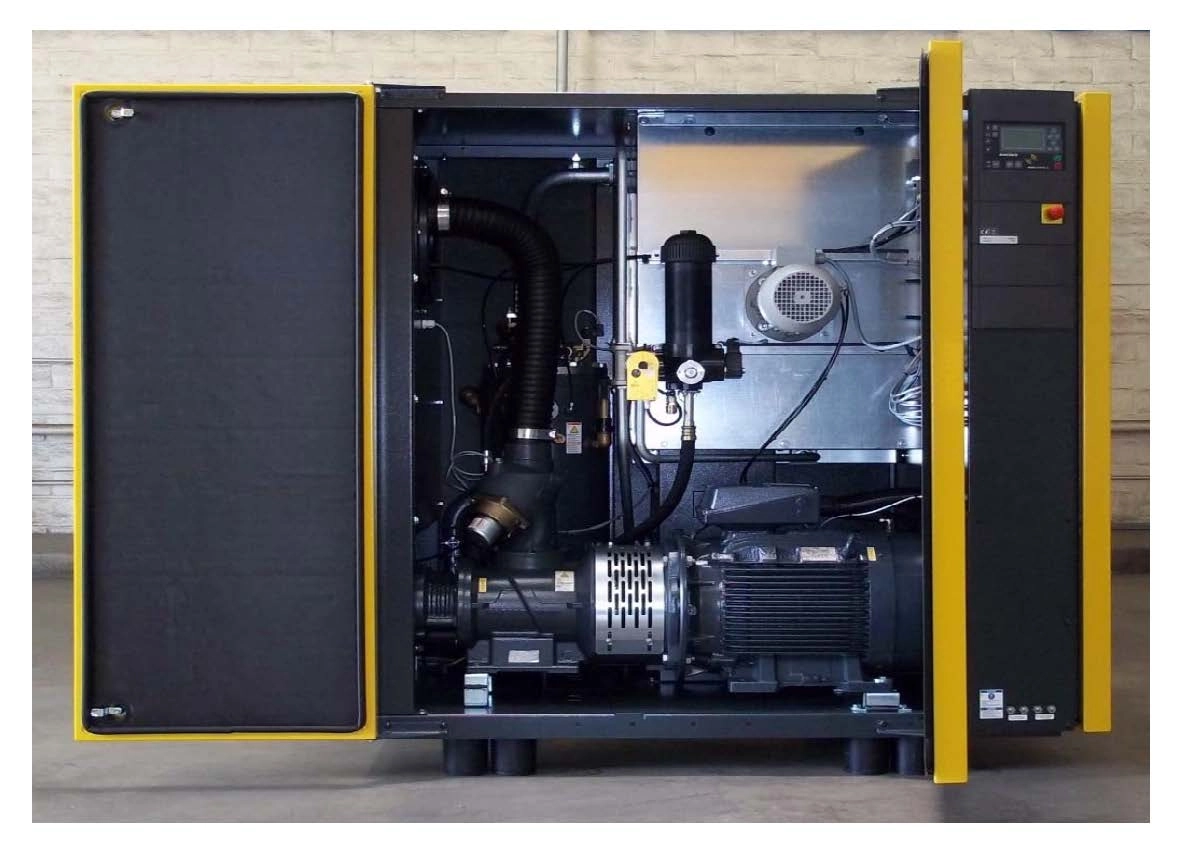
- Model and serial number. On Kaeser rotary screw compressors, the nameplate is on the exterior of the enclosure near the control panel. Read both the model (for example, ASD 40T) and the full serial number.
- Exact fault message from the display, or the fault code if the display shows one. "Overtemp" is not enough. "Code 0043, ADT rise dT/dt" tells the dispatcher which sensor to check and which spare parts to load.
- What happened in the 60 seconds before the shutdown. Load status, any unusual noise, whether facility power blinked, whether another compressor on the same manifold was running.
- What you've already tried, and what the result was. Reset attempts, restart attempts, and any operator-level checks above.
- Site access information. Gate code, dock hours, contact person on-site, and any lockout/tagout or plant-specific PPE requirements. A technician turned away at the gate at 3 AM is a full billing cycle wasted.
Keep this list at the compressor. When production is down, no one remembers where the serial plate is.
Why the Authorized Dealer Difference Matters at 2 AM
Any technician can reset a fault code. What separates an authorized Kaeser and Roots dealer from a general compressor shop during an emergency call comes down to three things.
OEM parts on the service truck. Airend rebuild parts, pressure relief valves, oil separator elements, temperature sensors, and control boards for the Kaeser and Roots lines. A generic shop calling around for a Kaeser sensor at 2 AM adds a day to the repair.
Access to manufacturer diagnostic tools and technical support. SIGMA CONTROL 2 diagnostics, factory technical hotline access, and warranty procedures that a non-authorized shop cannot use.
Warranty preservation. Non-authorized repair work on a unit still under Kaeser warranty voids remaining coverage on the affected system. A $500 sensor replacement done by an unauthorized shop can invalidate a $15,000 airend warranty.
The authorized-dealer difference is invisible when everything is running. It shows up at 2 AM.
Frequently Asked Questions
How long does emergency compressor repair take?
Emergency compressor repair time varies from 30 minutes for a controller reset or sensor swap to 6 to 8 hours for an airend replacement. Most Kaeser and Roots fault codes resolve within a single service call when the dealer arrives with OEM parts on the truck. The response time itself (how quickly a technician arrives after your call) depends on distance from the dealer's service base and time of day.
Should I try to restart my compressor after it shuts down?
Restart your compressor only if the fault code clearly matches an operator-resolvable cause (accidental E-stop, temporary overtemp after a cool-down, or a facility voltage event). Do not restart repeatedly against an active fault. Each attempted restart against a mechanical fault (bearing noise, oil carryover, locked airend) risks turning a routine service call into a major rebuild.
Do you offer 24-hour compressor repair service in Los Angeles?
American Compressor Company provides 24-hour emergency compressor repair service to Los Angeles County and Southern California from our Santa Fe Springs location. Our on-call technicians dispatch with Kaeser and Roots OEM parts on the truck for the most common emergency failures.
What information do I need to give when calling for emergency service?
Emergency service dispatchers need five pieces of information: your compressor model and serial number, the exact fault code on the display, what happened immediately before the shutdown, what you've already tried, and site access details. Having this ready at the point of call cuts dispatch time and increases the chance the technician arrives with the correct parts.
Can a compressor be damaged by running with a fault?
A rotary screw compressor can absolutely be damaged by running with an unresolved fault. The most common examples are running past an airend discharge temperature warning (which seizes the airend), continuing to run after oil separator failure (which contaminates the downstream system), and repeated restart attempts against a motor overload trip (which burns the motor).
24-Hour Compressor Service in Southern California
Compressed air uptime is not something you appreciate until it stops. When it stops at 2 AM on a Tuesday, the difference between a fast recovery and a rebuild is what you do in the first hour and who you have on speed dial.
American Compressor Company runs 24-hour emergency service for Kaeser rotary screw compressors and Roots rotary lobe blowers across Los Angeles County and Southern California from our Santa Fe Springs location. Our field technicians carry OEM parts for the most common Kaeser and Roots failures, and our dispatcher works from the same call script above so the right technician gets to your site with the right parts. Call 1-800-955-6188 for emergency service, or set up a preventive maintenance contract to reduce the odds of a middle-of-the-night call in the first place.